
Frequently asked questions

Questions behind the everyday choices

Sustainable eating raises practical questions about food, health, money and environmental claims. The answers below explain the underlying trade-offs. Use the search to find a topic, and follow the sources when you need more detail or guidance specific to your circumstances.

3 min read
01

Is local food always the better choice?

Local food can support particular communities and sometimes reduce transport, but distance alone does not establish a lower total footprint. For many foods, production dominates emissions. Beef produced nearby can have a much higher footprint than imported legumes. Air freight, heated growing conditions and storage can change particular comparisons.

Seasonality and local sourcing can be useful considerations, especially when connected to good farming practices and reduced waste. They should complement rather than displace attention to what is being produced. Ask about the whole system instead of treating a short journey or a country-of-origin label as proof of sustainability.

  • Consider the food type before the distance
  • Be attentive to air-freighted perishables
  • Support local options without making unsupported footprint claims
Source: Our World in Data · Environmental impacts of food
02

How do protein and vitamin B12 work?

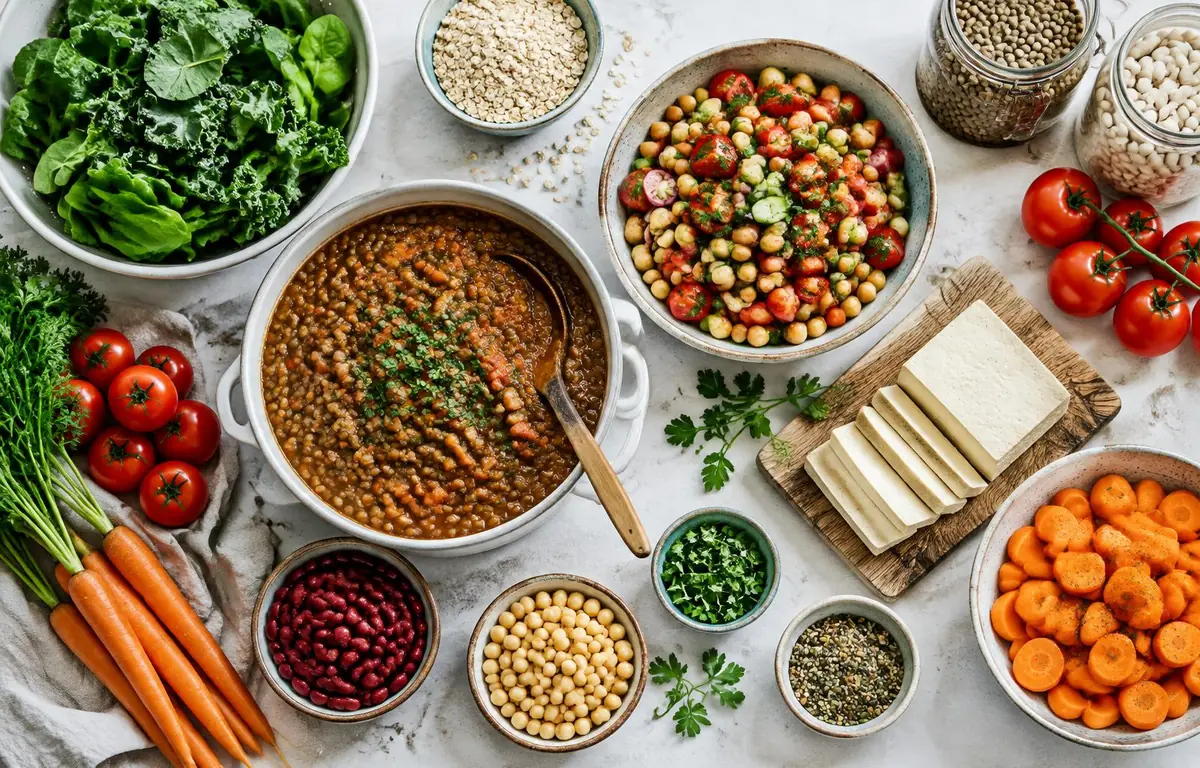
Legumes, tofu, tempeh, nuts, seeds and grains can contribute protein in a well-planned plant-based diet. Eat enough overall food and include substantial protein sources in main meals. Needs vary with age, activity and health. A varied plant-based pattern does not require combining exact amino-acid ratios at every meal.

Vitamin B12 requires a reliable source from fortified foods or supplements. Do not rely on seaweed, unfortified fermented foods or assumptions about soil. Calcium, iodine, iron, vitamin D and omega-3 also deserve planning. Qualified guidance is especially important during pregnancy, childhood or when medical conditions affect nutrition.

  • Include legumes or another suitable protein source regularly
  • Plan a reliable B12 source
  • Seek advice tailored to your life stage and health
Source: NHS · The vegan diet
03

Can plant-based eating fit a tight budget?

Beans, lentils, oats, rice and many frozen vegetables can be economical, while specialty substitutes can be expensive. The cost of a diet depends on local prices, food access, cooking facilities and time. It is therefore more honest to describe practical ways to reduce costs than to promise identical savings for everyone.

Start with familiar staple dishes and compare unit prices. Frozen or canned ingredients can reduce preparation work and spoilage. If food access is limited, prioritize workable changes over idealized menus. A budget-friendly plan should account for the resources you actually have, including a safe kitchen and adequate storage.

  • Choose staples before specialty substitutes
  • Compare cost per usable portion
  • Plan several meals around shared ingredients
Source: Our World in Data · Environmental impacts of food
04

Are organic, grass-fed and seafood labels enough?

These labels may describe specific practices or standards, but they do not settle every environmental question. Grass-fed beef still involves methane and land demand. Organic production addresses some inputs without necessarily reducing every footprint measure. Seafood sustainability varies with species, method, stock condition and the details of a certification scheme.

Treat a label as a piece of information to examine. Ask which impact it covers, what evidence supports it and whether it compares the product with lower-impact alternatives. A narrow improvement can be worthwhile without making the whole product sustainable. Avoid both automatic trust and blanket dismissal of every standard.

  • Read the actual standard behind a certificate
  • Compare several environmental dimensions
  • Ask whether the claim concerns practices or measured outcomes
Source: Poore & Nemecek · Science · 2018
05

Does one person matter, and must change be perfect?

One person’s sustained choices can influence demand and make alternatives more familiar to others. Exact individual savings vary, and there is no robust universal number of animals saved that applies to every diet. Personal action also cannot replace policies and infrastructure that make lower-impact options widely available.

Perfection is not required for progress. A gradual transition can build skills and reveal obstacles. What matters is moving toward repeatable changes while protecting nutrition and respecting circumstances. Sharing a good meal, requesting better institutional options and supporting public changes can extend the effect of a personal experiment.

  • Focus on sustained habits rather than a perfect label
  • Avoid universal individual savings claims
  • Combine personal choices with requests for broader change
Source: IPCC · Climate Change and Land · 2019

Make your next meal count

Join people around the world who have pledged to eat plant-based — for a week, a month or for good. It is free and takes less than a minute.

Take the pledge